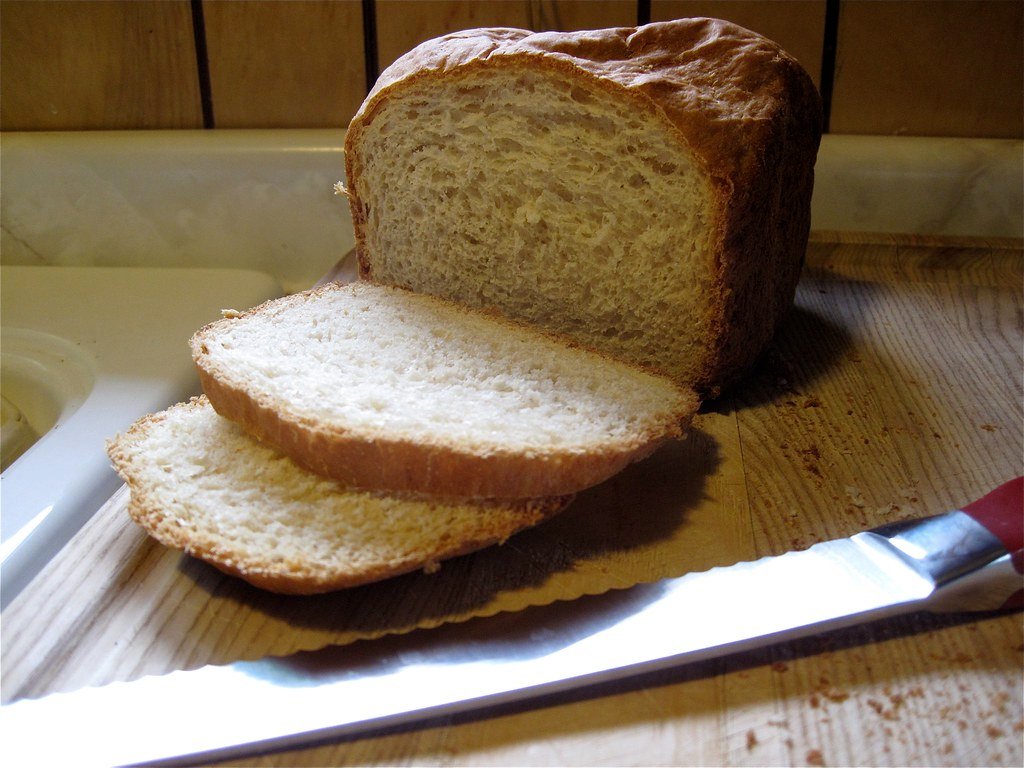
Most sourdough advice treats “my loaf didn’t work” as one problem. It isn’t. A gummy loaf, a dense loaf, and a flat loaf fail for different reasons, and fixing the wrong variable is why bakers stay stuck for months.
Start by identifying which one you actually have.
Quick diagnosis
- Gummy — the crumb is sticky or pasty, and the knife drags. Usually a baking or cooling problem.
- Dense — fully cooked but tight and heavy, small even holes. Usually a fermentation problem.
- Flat — it spread outward instead of rising up. Usually a structure problem: shaping, gluten, or over-fermentation.
Gummy crumb
Gumminess is almost always moisture that never left the loaf.
You cut it too early
This is the single most common cause, and the easiest to fix. Bread is still cooking as it cools. Starch needs to set, and steam needs to escape. Cut a loaf at twenty minutes and you release that steam into the crumb, where it condenses and turns pasty.
Fix: wait at least two hours. For a large, high-hydration loaf, four is better. It is agony and it works.
It’s underbaked
Colour is a bad doneness signal — a loaf can look beautifully dark and still be wet inside. Internal temperature is the reliable one. Lean bread is done at roughly 205–210°F (96–99°C) in the centre.
Fix: check with an instant-read thermometer. If it’s under, put it back in — out of the pot, directly on the rack — for another ten minutes.
Under-fermented dough
If the starch hasn’t been broken down by a long enough bulk ferment, the crumb can read as dense and gummy at once. See the next section.
Dense crumb
Dense bread that is cooked through is a fermentation failure, and it nearly always traces back to the starter.
Your starter wasn’t ready
A starter that hasn’t peaked doesn’t have the population to raise a loaf. “I fed it this morning” isn’t the test. The test is behaviour: it should roughly double, dome on top, and smell tangy but not like acetone. Use it at or just before peak.
The float test — a spoonful dropped in water — is a rough proxy, not gospel, but a starter that sinks like a stone is telling you something.
Bulk fermentation was too short
Recipes give times, but time is not the variable — temperature is. A dough at 78°F might finish bulk in four hours. The same dough at 65°F might need eight. If you bake by the clock in a cold kitchen, you will consistently under-ferment.
Fix: judge by the dough, not the timer. You want roughly 30–50% volume increase, a domed and jiggly surface, and some bubbles. Find the warmest spot in your house, or accept a longer clock.
Too much whole grain, too little water
Whole wheat and rye absorb far more water than white flour and their bran cuts gluten strands. Swapping in 30% whole wheat without raising hydration reliably produces a brick.
Flat loaves
A loaf that spreads into a puddle has lost its structure. Three suspects:
Over-fermentation
The opposite failure from dense. Left too long, the gluten network degrades and can no longer hold gas — the dough goes slack, soupy, and sharply sour. It will not recover. Bake it as a flatbread and shorten your bulk next time.
Weak gluten development
High-hydration dough needs strength built through stretch-and-folds or coil folds during bulk. Skip them and there’s no network to trap gas.
Flour matters too: bread flour has more protein than all-purpose and produces a noticeably stronger dough. If you are fighting slack dough, that’s the cheapest fix on this page.
Shaping that didn’t create tension
Shaping isn’t a formality — it builds a taut skin that directs expansion upward. If your dough ball slumps immediately on the counter, it has no surface tension. Pre-shape, rest 20 minutes, then shape firmly.
The one variable most people should change first
If you only adjust one thing: measure your dough temperature and stop baking by the clock. Nearly every dense loaf and a good share of flat ones come from treating a recipe’s “4 hours” as a fact rather than a description of someone else’s kitchen.
Steam is the other half
Oven spring — the fast rise in the first ten minutes — depends on the crust staying soft long enough to expand. That requires steam. A home oven vents it away almost immediately, which is why a lidded pot works so well: it traps the dough’s own moisture. If your loaves are dense and pale with a thick crust, lack of steam is likely part of it. See our guide to choosing a Dutch oven for bread.